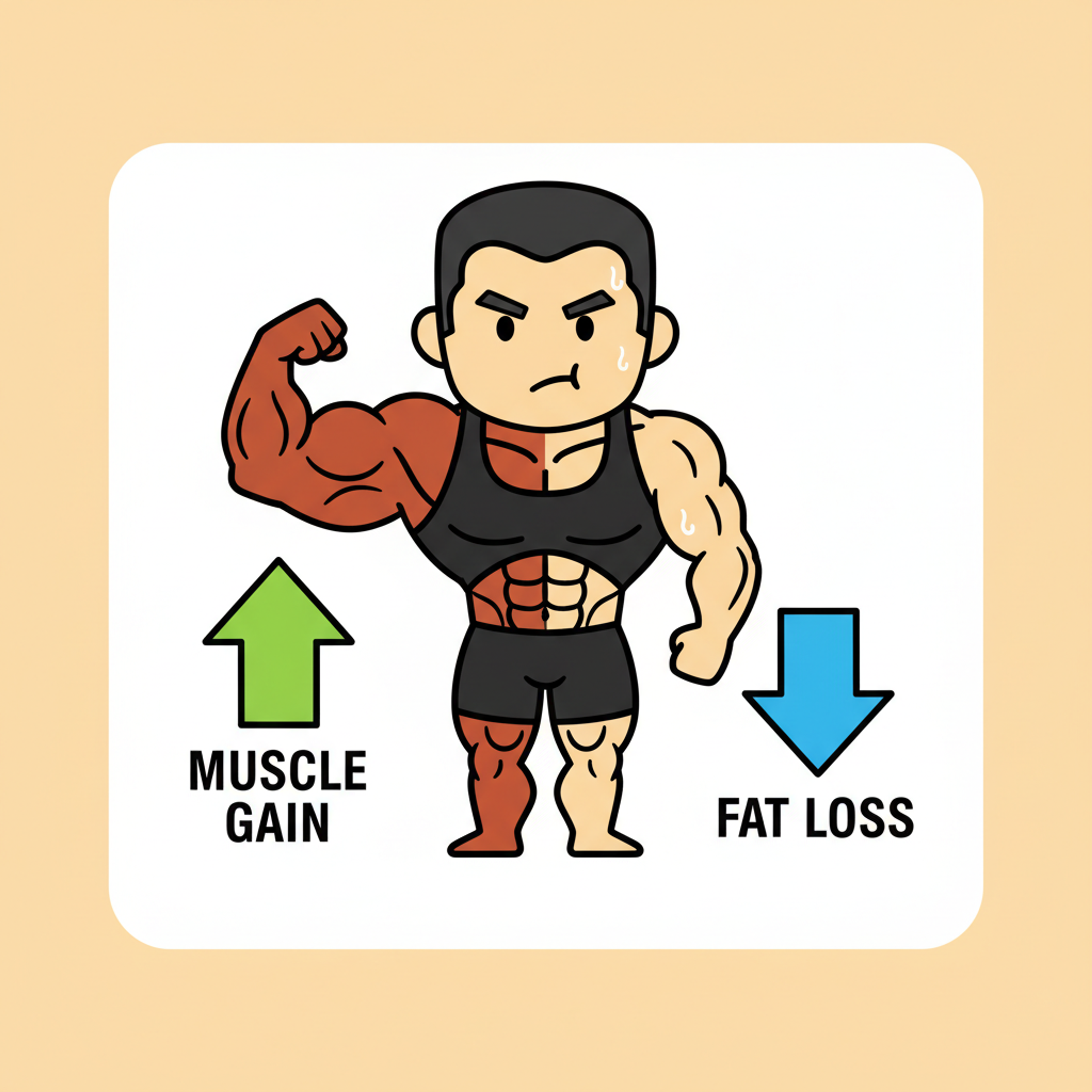
Body recomposition — gaining muscle and losing fat simultaneously — is real. It is also frequently overhyped and often applied to people it will not work for.
Here is the honest version.
The Basic Conflict
Building muscle requires a caloric surplus (or at minimum, sufficient calories to support protein synthesis alongside energy demands). Losing fat requires a caloric deficit. These two conditions are physiologically opposed.
In practice, you cannot fully optimize for both simultaneously. Something always wins and something always loses ground.
This is why experienced lifters use distinct bulking and cutting phases — alternating between building muscle with a surplus and losing fat with a deficit, cycling over months.
When Recomposition Works
Despite the conflict, recomposition is achievable in specific populations:
Beginners. In the first 6–12 months of training, the muscle-building stimulus is so strong that even a caloric deficit does not prevent meaningful muscle growth. The body adapts aggressively. This is the closest thing to a free lunch in physiology.
Previously trained individuals returning after a layoff. Muscle memory allows rapid muscle regain even in a deficit. The myonuclear infrastructure is already there.
People with high body fat. Stored body fat is essentially an internal energy reserve. A person carrying significant excess fat can mobilize it to support both the caloric demands of daily life and the energy demands of muscle protein synthesis, even when dietary intake is below maintenance.
Steroid users. Performance-enhancing drugs dramatically alter the muscle protein synthesis ceiling, enabling simultaneous gains and fat loss at scales not achievable naturally. This is relevant context when evaluating influencer claims.
When Recomposition Does Not Work Well
Lean, intermediate-to-advanced natural lifters. If you are already relatively lean and have years of training history, your muscle-building potential is modest and your fat stores are limited. There is not enough internal energy reserve to fuel meaningful muscle growth in a deficit. You will spin your wheels — making marginal gains on both fronts while optimizing neither.
How to Approach It Practically
If recomposition is your goal and you fall into one of the populations it works for:
- Eat at or near maintenance — not a significant deficit, not a surplus. Roughly ±100–200 kcal of maintenance.
- Prioritize protein. 1.6–2.2g per kg of bodyweight. Protein provides the substrate for muscle synthesis and has the highest thermic effect of any macronutrient.
- Train progressively. Recomposition requires a strong training stimulus. If you are not pushing hard in the gym, there is no signal to build muscle.
- Be patient. The scale will not move much. Body composition is changing under the surface. Progress photos and strength metrics are more informative than scale weight.
The Honest Expectation
If you are a beginner: recomposition will happen almost automatically with solid training and adequate protein. Do not overthink it.
If you are intermediate and lean: stop chasing both simultaneously. Spend 4–6 months building, then spend 8–12 weeks cutting. You will end up ahead of where you would have been trying to do both half-heartedly.
About Rasmus
Powerlifter and coach with more than 7 years in the game.
Related Articles
Does Arm Training Actually Matter for Your Bench
The conventional wisdom in powerlifting: don't bother with curls, your arms get enough work from the big lifts. The conventional wisdom in bodybuilding: arms need direct work to grow. Both camps are p
Will Powerlifting Get You Jacked
Yes. Also no. It depends on what you mean by jacked and how you are training.
How Long Does Muscle Take to Come Back After a Layoff
You have taken time off. Life happened — illness, travel, injury, work, a new baby. You come back to the gym and you are weaker than you were. The muscle you spent years building appears to have disap