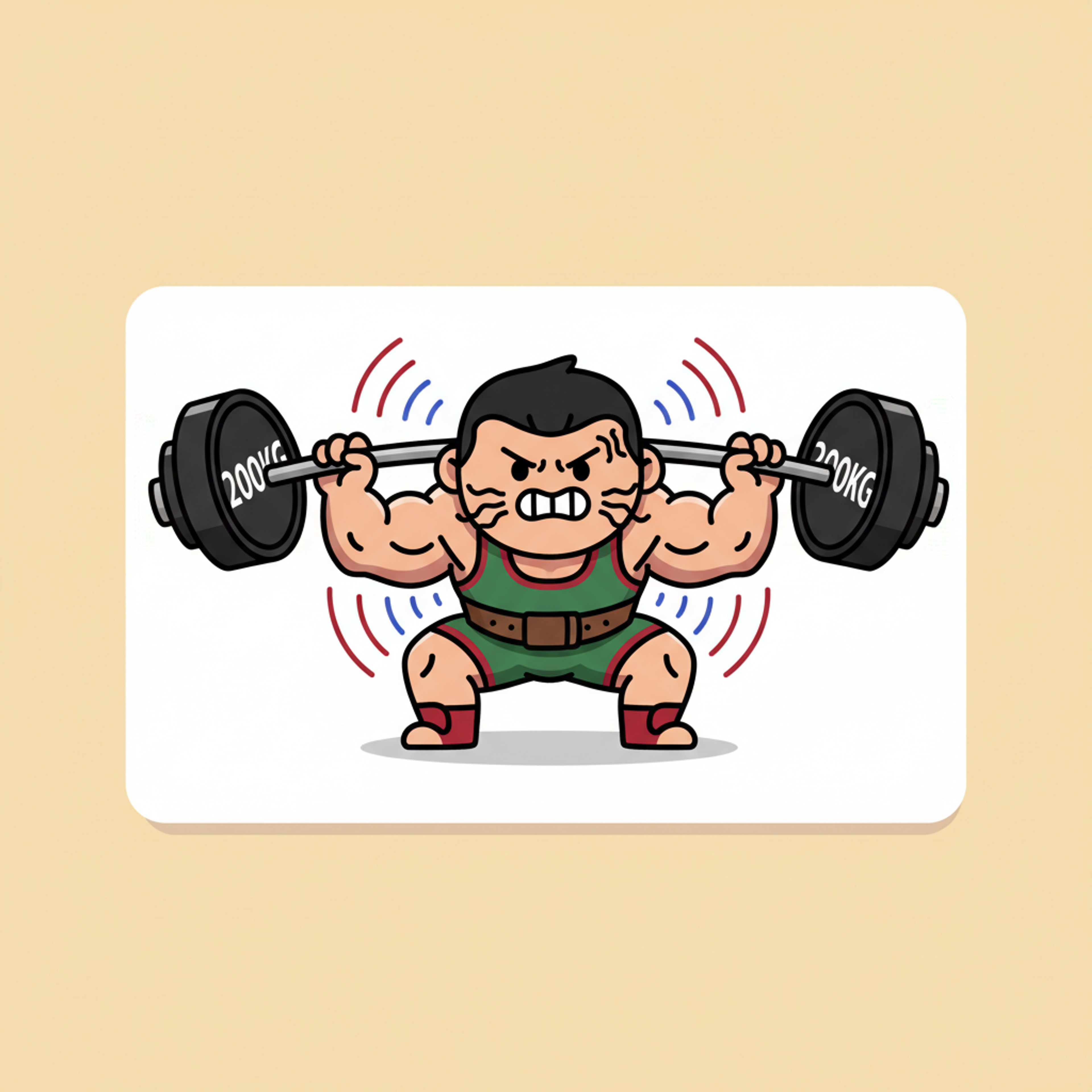
Breathing during a heavy lift is not instinctive. The instinct — especially under maximal loads — is to hold your breath and hope for the best. That instinct is actually correct. But most people apply it wrong.
The Mechanism: Intra-Abdominal Pressure
The spine is not a fixed column. It is a stack of bones separated by soft discs, stabilized by the surrounding musculature. Under load, without proper stabilization, the spine can buckle.
The solution is intra-abdominal pressure (IAP).
When you fill your lungs and brace your core against a sealed glottis, you create a pressurized cylinder inside your torso. That cylinder acts as a hydraulic brace, compressing and stabilizing the spine against compressive and shear forces.
This is the Valsalva maneuver — and it is the single most important technical element for safely moving heavy loads.
The Valsalva Maneuver
- Take a deep breath. Breathe into your belly — not your chest. You want your diaphragm moving downward, expanding your abdomen outward in all directions. This maximizes the pressurizable volume.
- Brace your core. Not sucking in, not pushing out dramatically — creating 360-degree tension, as if bracing for a punch.
- Close your glottis. Not forced exhalation. Sealed throat, pressure held.
- Perform the rep. IAP remains elevated through the sticking point.
- Breathe out at the top (for squats and deadlifts) or between reps.
The common mistake is breathing out at the hardest point of the lift — the bottom of the squat, the sticking point of the deadlift. This is exactly when IAP needs to be highest and when releasing it is most dangerous.
When to Take Your Breath
Heavy singles and low-rep sets: One breath per rep. Reset at the top. Full Valsalva each time.
Higher rep sets (8–15 reps): You have two options:
- Full Valsalva each rep, resetting at the top between reps
- Breathe at the top of the rep when the load is most mechanically supported
During the descent (squat, RDL): Breath is taken and held before initiating the descent. Do not breathe on the way down and attempt to re-brace at the bottom.
Bench Press Nuance
Bench press follows the same principle. Take your breath before unracking the bar, brace, lower under control, press. Breathe at the top.
The added consideration for bench: your brace affects your arch. Breathing into your belly (not your chest) helps maintain the thoracic arch that provides stability and reduces the range of motion the bar has to travel.
Breathing Between Sets
This is less discussed but matters for high-rep work and people training in hot conditions. Between sets, breathe normally — in through the nose, out through the mouth. Avoid hyperventilating to try to "get more oxygen" — it depletes CO2, which can cause lightheadedness when you brace again.
What About Blood Pressure?
The Valsalva maneuver transiently spikes blood pressure. This is normal and self-resolving. It is the mechanism by which the technique works.
For healthy individuals, this transient spike is not a concern. For individuals with diagnosed hypertension or cardiovascular issues, training under heavy load warrants medical guidance regardless of breathing technique.
Breathe correctly. The alternative — letting IAP collapse under a heavy squat — is considerably more dangerous than a momentary blood pressure spike.
About Rasmus
Powerlifter and coach with more than 7 years in the game.
Related Articles
What Weight Class Should You Actually Compete In
Most first-time powerlifters pick a weight class the same way they pick a shirt size: by their current bodyweight. That is the wrong framework.
Should You Do Speed Work
Speed work sounds like it's for athletes. You are a powerlifter. You lift heavy things slowly.
How to Pick Your Opener
Your opener is the most important lift of the meet. Not your third attempt. Not your all-time PR. The first lift.