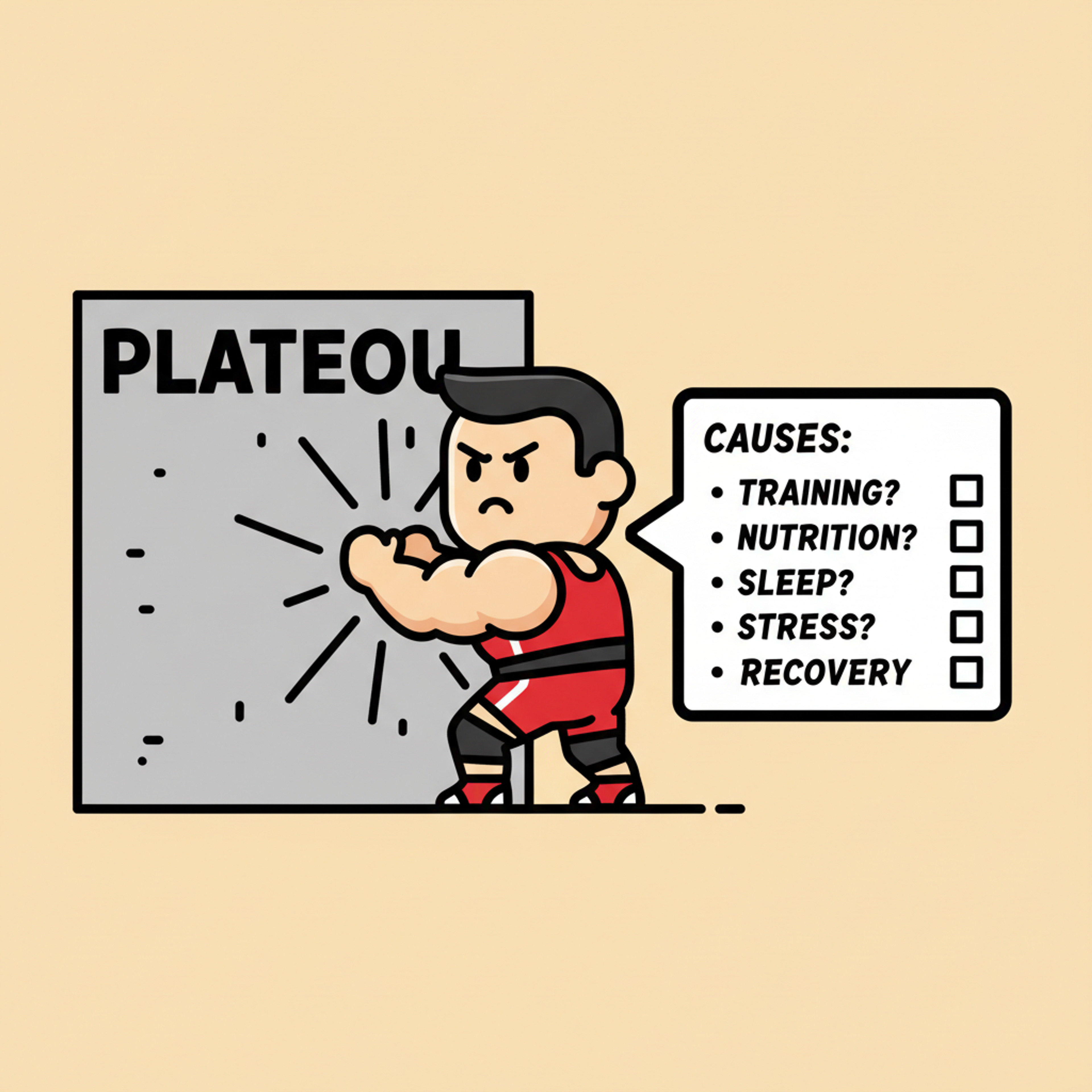
A plateau is not bad luck. It is information. The question is what it is telling you.
Most people hit a wall and respond by doing more of what stopped working. More sets of the same thing, more days in the gym, more intensity on the same movements. The result is the same wall, faster.
Here are the four actual reasons progress stalls, and what to do about each.
1. You Are Not Progressing the Overload
The most common cause of stagnation is deceptively simple: you are doing the same workout you did three months ago.
Progressive overload is not optional. The body adapts to a given stimulus and stops responding to it. If the stimulus does not change, adaptation stops.
This does not always mean adding weight to the bar. Progressive overload includes:
- More reps with the same weight
- More sets at the same intensity
- Shorter rest periods with the same volume
- Greater range of motion
- Better technique that increases muscle demand
If none of these are changing, you are not training — you are maintaining.
The fix: Track your training. Every session should show at least one metric improving over the previous session on the same movement.
2. You Are Accumulating Too Much Fatigue
Counterintuitively, a plateau can mean you are doing too much, not too little.
When accumulated fatigue exceeds recovery capacity, performance suffers. You feel flat, motivation drops, and the weights that used to move smoothly start grinding. Many lifters interpret this as weakness and push harder, compounding the problem.
Signs you are overreaching: persistent soreness, declining performance across multiple sessions, poor sleep quality, irritability, elevated resting heart rate.
The fix: A deliberate deload. One week at 50–60% of normal volume, keeping intensity moderate. Most lifters who have been plateaued for weeks break through to new PRs the week after a deload — the recovery was the missing ingredient.
3. You Are Under-Eating
Muscle protein synthesis is an energy-expensive process. Building and repairing tissue requires substrate. If you are chronically eating below the caloric requirements of your training, progress will stall regardless of how well you program.
This is especially common in lifters who are simultaneously trying to stay lean. The surplus required to support muscle growth is small, but it must be there.
The fix: Track your food for a week without changing anything. Most people who stall on muscle gain are eating significantly less than they estimate.
4. You Have Adapted to Your Exercise Selection
The body adapts not just to load but to specific movement patterns. After 8–16 weeks on the same exercises, the adaptive stimulus of those exercises decreases even when load increases.
This is why periodization models include variation. Rotating exercises — using a box squat instead of a back squat for 6 weeks, switching from barbell rows to chest-supported rows — presents novel mechanical stimuli and recruits motor units in slightly different patterns.
The fix: Introduce a variation of your primary movements for a training block (4–8 weeks), then return to the original. The original movement often feels fresh and productive again.
The Diagnostic Question
Before you add volume, change your program, or buy a new supplement, ask: have I honestly and consistently applied progressive overload, am I recovering adequately, am I eating enough, and have I been doing the same exercises for too long?
One of these four is almost always the answer.
About Rasmus
Powerlifter and coach with more than 7 years in the game.
Related Articles
Should You Do Speed Work
Speed work sounds like it's for athletes. You are a powerlifter. You lift heavy things slowly.
Should You Use a Belt in Training
The belt debate produces more heat than light. One camp says never use a belt — you need to build raw core strength first. The other says always wear a belt — protect your spine at all costs.
Does Arm Training Actually Matter for Your Bench
The conventional wisdom in powerlifting: don't bother with curls, your arms get enough work from the big lifts. The conventional wisdom in bodybuilding: arms need direct work to grow. Both camps are p