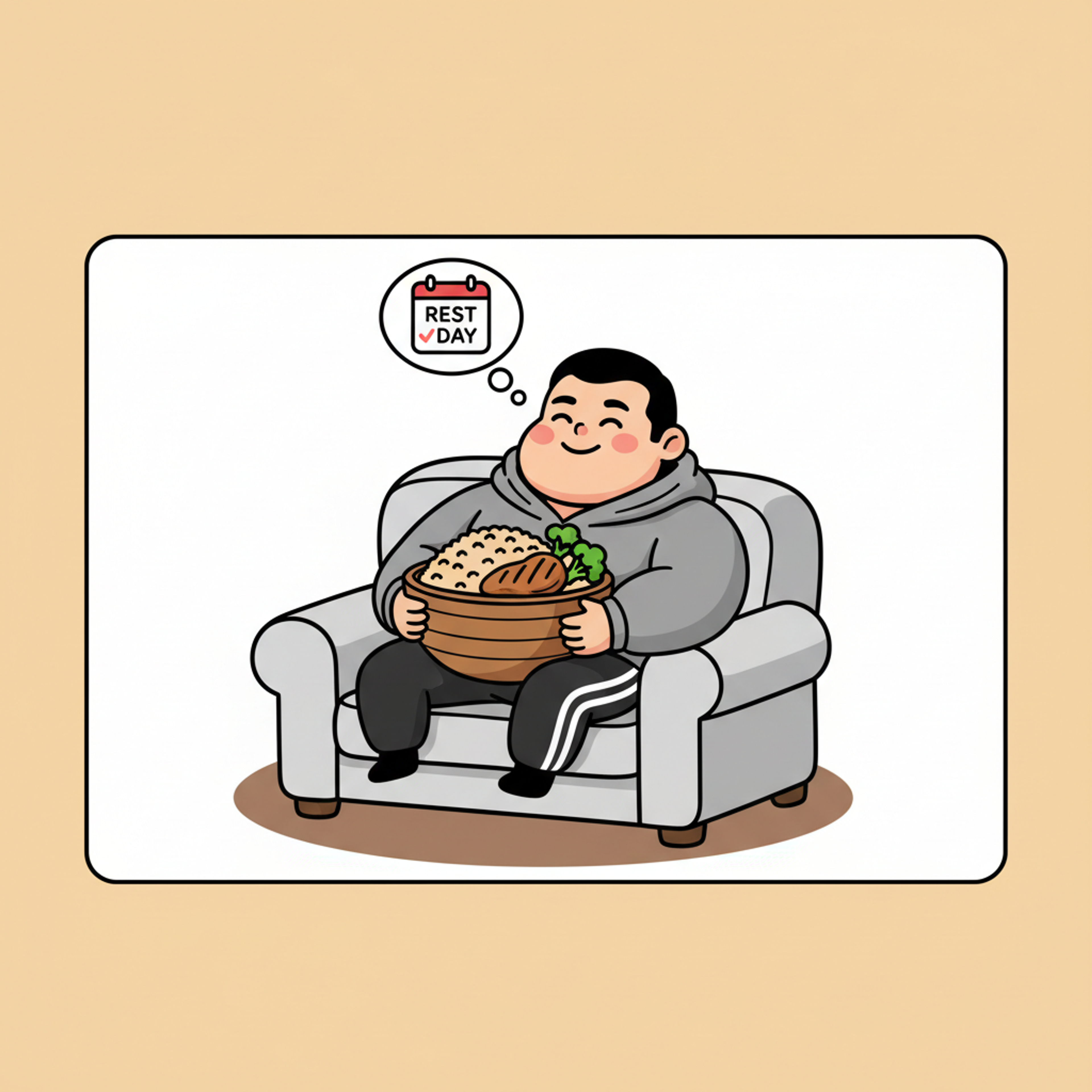
Rest days produce a lot of unnecessary anxiety. Do you eat less? Do you cut carbs? Do you maintain exactly what you eat on training days?
The overcomplicated version: adjust macros based on energy expenditure calculations, cycling calories and carbs to match daily training demands.
The practical version: eat roughly the same as training days, with minor adjustments.
Why Rest Days Don't Require a Dramatic Diet Shift
Muscle protein synthesis (MPS) — the process of building muscle — is elevated for 24–48 hours after a training session. On your rest day, you are still building from yesterday's workout.
Cutting calories aggressively on rest days directly undercuts this process. The amino acids and energy substrate for MPS need to be available during the recovery window, which extends well past the training session itself.
The Energy Expenditure Argument
The reason some people eat less on rest days is valid: you are burning fewer calories. No training session means no exercise energy expenditure. You may burn 200–500 fewer calories on a rest day depending on training intensity.
However:
- Total daily energy expenditure (TDEE) does not drop dramatically. Base metabolic rate, NEAT (non-exercise activity thermogenesis), and thermic effect of food are all still operating normally.
- The difference is smaller than most people assume. A 45-minute lifting session burns 250–400 kcal. Spread over a day, this is a small fraction of TDEE.
Practical Adjustments That Make Sense
Slightly reduce carbohydrate intake. Carbohydrates are primarily a fuel source for training. On rest days, demand is lower. Reducing carbs by 50–100g is reasonable if you are managing body composition carefully.
Maintain protein. Protein needs do not decrease on rest days — they may even be slightly higher, as the muscle repair process draws on amino acids. Hit the same protein target.
Maintain fat. Fat intake supports hormonal function, joint health, and fat-soluble vitamin absorption. No reason to cut it on rest days.
The Simple Version
If you are not a competitive athlete doing precise macro cycling, this is all you need:
- Eat your normal meals.
- Maybe skip the post-workout shake or the extra bowl of rice you had to fuel the session.
- Prioritize protein and vegetables.
- Do not binge because "it's a rest day and I earned it."
- Do not starve because "I'm not training today so I don't deserve food."
Rest days are when your body does the actual work of adaptation. Feed the process.
About Rasmus
Powerlifter and coach with more than 7 years in the game.
Related Articles
Small Surplus vs Big Surplus
You want to build muscle. Someone told you to eat in a calorie surplus. Now you need to know how big that surplus should be.
Should You Eat Before You Work Out
The fear: train fasted and your body will eat your muscle for fuel. The counter-fear: eat too close to training and you will be nauseous under a heavy squat.
Can You Build Muscle While Losing Fat
Body recomposition — gaining muscle and losing fat simultaneously — is real. It is also frequently overhyped and often applied to people it will not work for.